Free tools for CFD and FEA engineers
Each tool is built around a method that has to be defensible in a report: the convergence maths behind a CFD mesh study, the percentage difference between a predicted and a measured value, and the token-by-token reading of an Ex marking. Where a method needs explaining, the tool links to the article that does it.
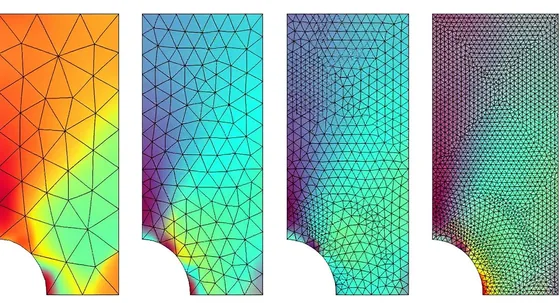
Enter three mesh levels and get the observed order of convergence, Richardson extrapolation, the Grid Convergence Index and an asymptotic-range check — the numbers a grid independence study has to report.
Calculator — GCI formula and Richardson extrapolation for a three-mesh convergence study, with the range check that flags a study you cannot trust.
Compare predicted and measured values per quantity: percentage difference, ratio and a tolerance-band flag, so a correlation table in a report is arithmetic you can check rather than a claim you have to trust.
Checker — model validation arithmetic for simulation-versus-test comparisons, quantity by quantity, with the tolerance band you set.

Paste an Ex marking and read it token by token: equipment group, category, zone suitability, EPL, gas and dust groups, temperature class — with the reference tables alongside.
Decoder — how to read an Ex code on equipment, with the standard tables for gas groups, dust groups and T-classes.

Enter the equipment type, fluid group, PS and volume or DN to find which Annex II table of Directive 2014/68/EU governs it, where PS × V or PS × DN puts it, and which conformity assessment modules that implies.
Reference — the nine Annex II tables, the Article 4(1) scope thresholds and the exceptions that raise a category, as values rather than graphs.
How the tools are built
All three are plain HTML and JavaScript with no third-party request: nothing is sent to a server, there is no account and no cookie. The method behind each one is written out in the companion guide — start with how to run a grid independence study, then FEA versus physical testing for the correlation case, or ATEX zone classification for the marking one.
Need the study, not just the calculator?
These tools cover the arithmetic. The engineering judgement behind a convergence study or a correlation programme is what we do on client projects — tell us what you are validating and we will respond within one business day.