What CHS Intl does
The practice is deliberately narrow: numerical engineering that answers a question a project actually has, and the compliance work that depends on it. Five areas, in two halves.
Simulation
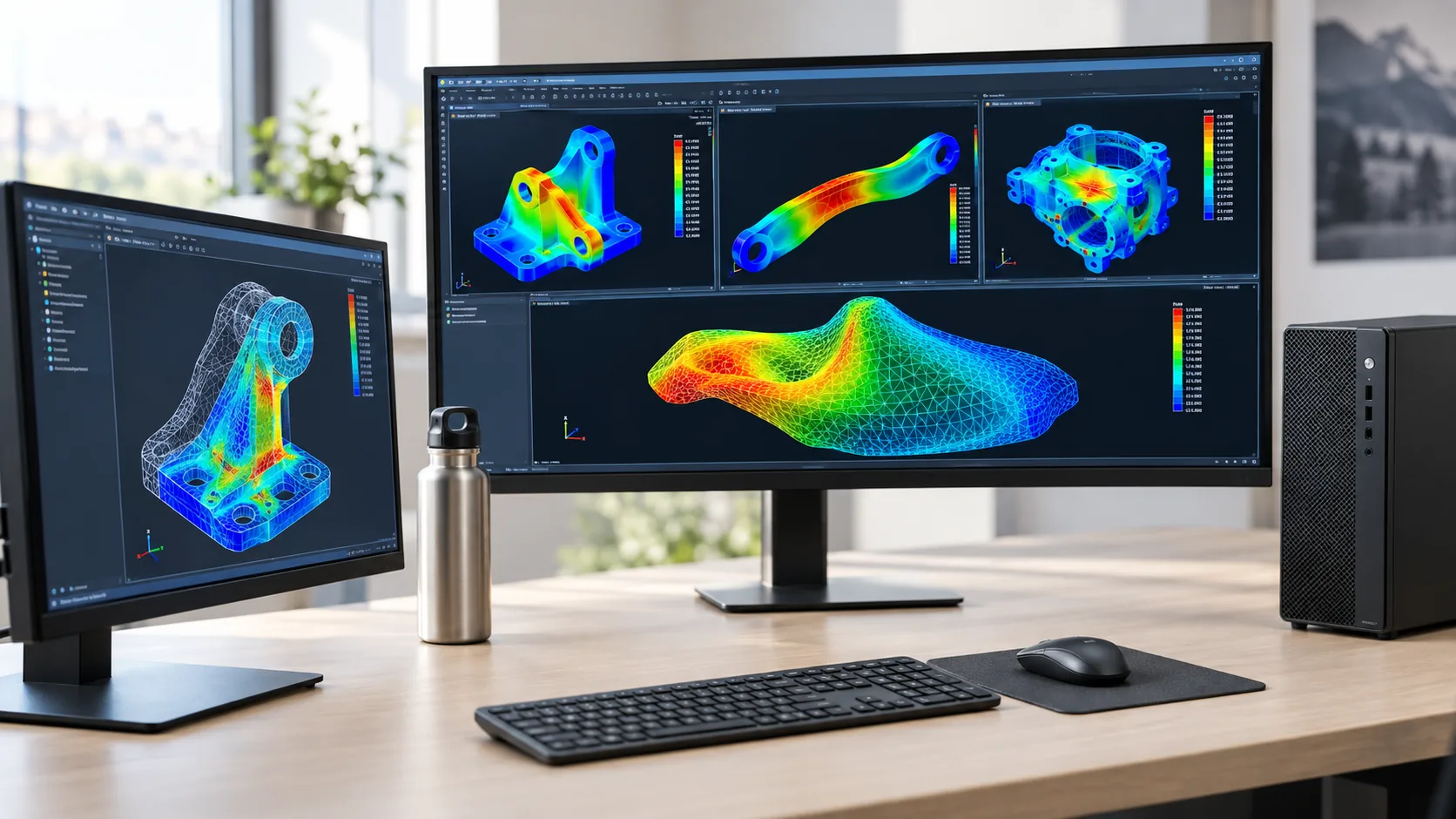
- FEA structural analysis — stress, stiffness, buckling, fatigue and contact behaviour in components and assemblies.
- CFD simulation — flow, heat transfer, pressure drop and mixing, including mesh independence studies that quantify the numerical error rather than assume it away.
- Acoustics and NVH — sound radiation, modal behaviour, and vibration transfer paths.
- Design optimisation — parametric studies and topology work where the question is which design is best, not merely whether one passes.
Compliance
- ATEX compliance — hazardous area classification, equipment selection and marking, and the documentation that supports the assessment.
- PED compliance — conformity assessment routes, technical documentation and design-by-analysis work for pressure equipment under Directive 2014/68/EU.
The two halves meet in the middle more often than they look: a pressure vessel evaluated by design by analysis is an FEA job with a directive attached, and an ATEX zone drawing is only as good as the dispersion or release calculation behind it.
How the work is done
Every study follows the same four steps, and the fourth is the one that makes the first three worth anything.
-
Define the question — agree up front which quantity has to be predicted, at which load case, to what accuracy. A model that answers an unasked question is worse than no model, because it looks like evidence.
-
Build and verify the model — geometry, material data, boundary conditions and contacts are documented as assumptions. For CFD that includes a mesh independence study, with the convergence numbers reported rather than asserted.
-
Validate against reality — where test data or field measurements exist, the model is correlated against them and the difference is quantified per quantity, not averaged into a single reassuring figure. Where no data exists, that limitation is stated.
-
Document and hand over — the report states the result, the assumptions it rests on, and the range of loads, temperatures and materials for which the model has been checked. Outside that range the model is a hypothesis again, and the report says so.
Standards and frameworks
The work is carried out against the standards that govern the specific equipment or assessment. The ones this practice works with most often:
| Standard or framework | What it governs |
|---|---|
| ATEX Directive 2014/34/EU | Equipment and protective systems intended for use in potentially explosive atmospheres placed on the EU market |
| IEC 60079-10-1 and -10-2 | Classification of hazardous areas — gas and vapour, and combustible dust respectively |
| IEC 60079-0 and the IEC 60079-14 / -17 series | General equipment requirements; installation, inspection and maintenance of Ex equipment |
| Pressure Equipment Directive 2014/68/EU | Conformity assessment of pressure equipment and assemblies above 0.5 bar |
| EN 13445 series (incl. EN 13445-3) | Unfired pressure vessels — design, and design by analysis |
| EN 13480, EN 12952 and EN 12953 | Industrial piping, water-tube boilers and shell boilers |
| EN 10028 and EN 10216 | Flat products and seamless tubes for pressure purposes |
| EN 10204 | Types of inspection documents supplied with metallic products |
| ASME BPVC Section VIII | Alternative pressure vessel design code, where the client's market or specification calls for it |
Nothing on this page is a certification claim. Notified body certification, where a project requires it, is issued by the notified body — this page describes the engineering and documentation work that precedes and supports it.
Who the work is for
Design and R&D teams that need an analysis they can defend in a design review; manufacturers, importers and authorised representatives preparing technical documentation for the EU market; and engineering firms who need a specialist second pair of eyes on a model someone else built.
Contact
Describe the component or the assessment in a sentence or two, and include whatever drawings, specifications or standards the project is bound by. You will get an answer about scope and approach before anything else.
Free tools. Three reference tools come out of this work, all usable without an account: the mesh independence calculator (order of convergence, Richardson extrapolation and the GCI), the FEA test correlation checker (predicted versus measured, per quantity), and the ATEX marking decoder for reading an equipment nameplate such as II 2G Ex db IIC T4 Gb.