What is CFD?
Computational Fluid Dynamics (CFD) uses numerical methods to solve the Navier-Stokes equations governing fluid flow, heat transfer, and species transport across a discretised domain. Rather than building expensive physical wind-tunnel or thermal tests, CFD lets you explore hundreds of design variants quickly and at a fraction of the cost.
CHS Intl's CFD team handles the full simulation chain — geometry cleanup, meshing, solver setup, post-processing and engineering reporting — for both steady-state and transient problems. Whether you need a single aerodynamic assessment or a full parametric sweep across 50 design variants, we deliver clear, quantitative results that drive confident engineering decisions.
Our CFD Capabilities
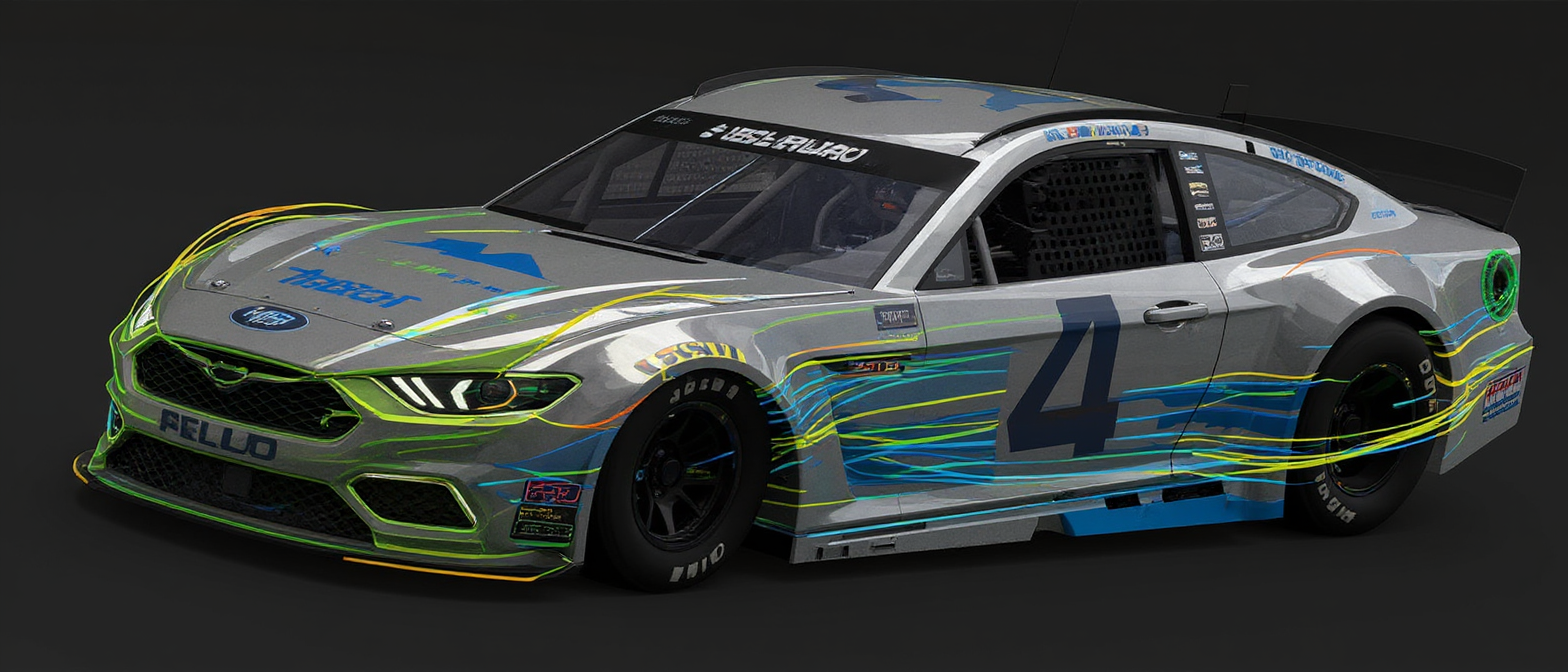
- External aerodynamics (drag, lift, downforce)
- Internal duct & manifold flow
- Conjugate heat transfer (CHT)
- Natural & forced convection cooling
- Multiphase flow (VOF, Euler-Euler, DPM)
- Turbomachinery (fans, pumps, compressors)
- Fluid-Structure Interaction (FSI)
- Combustion & reacting flows
- HVAC & building ventilation
- Offshore & marine hydrodynamics
- Transitional & turbulent flows (RANS, LES, DES)
- Rotating reference frames & MRF
Software We Use
- ANSYS Fluent
- Siemens Star-CCM+
- OpenFOAM
- ANSYS CFX
- COMSOL Multiphysics
Industry Applications
Our CFD Process
-
Geometry Preparation — CAD cleanup, surface extraction, and domain definition (farfield, inlets, outlets, walls).
-
Meshing — Volume mesh generation with boundary layer resolution appropriate to the target Reynolds number and flow physics.
-
Physics & Boundary Conditions — Turbulence model selection, inlet/outlet profiles, thermal boundary conditions, and rotation settings configured.
-
Steady or Transient Solve — Iterative solution run to convergence, monitored via residuals and key engineering quantities (forces, temperatures, pressure drop).
-
Post-Processing — Flow visualisation (streamlines, contours, vectors), integral quantities (Cd, Cl, Nu, pressure drop), and animated transient results.
-
Engineering Report — Findings delivered as a clear, client-ready report with methodology, results, and design recommendations.
Example Outcome
An automotive Tier 1 supplier was experiencing recurring heat shield failures on an exhaust-adjacent component during vehicle-level thermal testing. With a production launch eight weeks away, physical re-testing was not an option. CHS Intl built a conjugate heat transfer (CHT) CFD model in Siemens Star-CCM+ within three days, simulating underhood airflow at three critical drive cycles. The model identified a recirculation zone trapping hot exhaust gases against the component surface — a root cause invisible to thermocouple measurements. A targeted baffle was added to the CAD and re-simulated within 24 hours, confirming a 140 °C peak temperature reduction.
140 °C peak temperature reduction — production launch on scheduleValidation & Quality
All CHS CFD studies include a documented mesh independence study and comparison against available analytical benchmarks or experimental data where applicable. Uncertainty quantification is provided on request.
Frequently Asked Questions
What is CFD simulation and when do I need it?
Computational Fluid Dynamics (CFD) is a numerical method for solving the equations that govern fluid flow, heat transfer, and species transport. You need it whenever the behaviour of a gas or liquid critically affects your product performance — for example, drag on a vehicle, cooling of electronics, pressure drop through a valve, or mixing in a reactor. CFD replaces expensive physical wind-tunnel and thermal tests with digital experiments that can be run in hours or days.
What is the difference between ANSYS Fluent and Siemens Star-CCM+?
Both are industry-leading CFD solvers with overlapping capability. ANSYS Fluent excels in academic and aerospace applications, offers a vast library of turbulence and multiphase models, and has extensive validation documentation. Siemens Star-CCM+ is renowned for automated meshing, polyhedral mesh quality, and CAD-embedded workflows, making it particularly productive for complex automotive and industrial geometries. CHS Intl selects the most appropriate solver based on your physics, geometry complexity, and turnaround requirements.
How long does a CFD analysis take?
A steady-state external aerodynamics study (e.g. drag of a vehicle or building) typically takes 5–8 business days from CAD receipt to report. Transient analyses, multiphase flows, or conjugate heat transfer cases with complex geometries may require 10–20 business days. We scope the timeline accurately at project start and confirm it before work begins.
What turbulence model should be used for my CFD simulation?
Turbulence model selection depends on the flow regime and the quantities of interest. The k-ω SST model is the industry standard for external aerodynamics and attached boundary layers. The k-ε Realizable model suits fully turbulent internal flows. LES (Large Eddy Simulation) is used when accurate unsteady flow structures or aero-acoustic noise sources are required, at higher computational cost. CHS Intl documents the turbulence model choice and its justification in every report.
Can CFD replace wind tunnel or thermal testing entirely?
CFD significantly reduces — but rarely fully replaces — physical testing. Simulation is invaluable for early design screening, design space exploration, and understanding flow physics in detail. Physical tests provide ground truth for critical certification data and for validating simulation models. The most efficient approach, as used by Siemens and ANSYS customers, is a simulation-led development process with targeted physical validation at key milestones.
What geometry format do you need for a CFD study?
STEP or IGES files are preferred as they are solver-neutral and preserve surface quality. STL files are accepted for external aerodynamics (e.g. from 3D scans). For internal flow analyses, a water-tight solid model of the fluid domain is needed — we can extract this from your CAD assembly if required. The cleaner the geometry, the faster we can deliver results.